



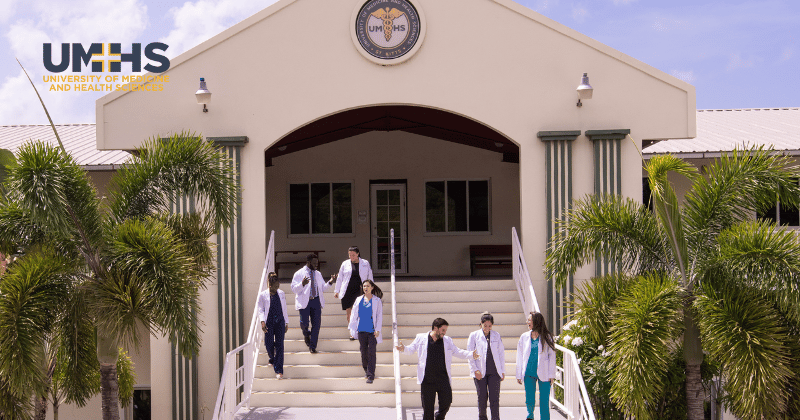

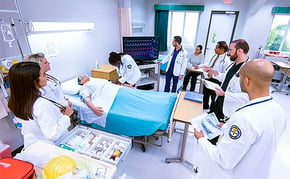



Choosing the correct medical school to apply to is challenging. One must consider many factors when making their decision: MD vs DO, location, size of school, etc. This decision is not one to make lightly. Given the small number of medical schools in Canada, Canadian pre-medical students may face especially challenging decisions when choosing schools in different locations. In this article, we discuss Caribbean medical school requirements for Canadian students, whether the MCAT is required, how hard it is to match into residency as an IMG, the cost of different medical schools, how the University of Medicine and Health Sciences (UMHS) fits in, and more.
Quick Navigation Links + FAQs
- Requirements for Canadian students?
- Is Caribbean Medical School valid for Canadians?
- Is it worth it to go to a Caribbean medical school if I am Canadian?
- How hard is it to get into a Caribbean med school if I am Canadian?
- How hard is it to get a residency?
- Do Caribbean medical schools give an MD degree upon graduation?
- Do I need to take the MCAT?
- Is it cheaper to go to med school in the Caribbean?
- Do Caribbean Medical schools have a bad reputation?
- Getting started in medicine
Caribbean medical schools for Canadian students requirements
In general, Caribbean medical school application requirements for Canadian students are similar to those for students from the United States. Schools require the same coursework, such as chemistry, biology, and physics. The main difference is whether or not the Medical College Admission Test (MCAT) is required. Most Caribbean medical schools do not directly require the exam for Canadian students. Each school has its own policy regarding the exam. However, most do not require the MCAT score for admission. Some may encourage or suggest the exam as part of the application process. Pre-medical students are encouraged to check with each individual school they are applying to for their policy.
Is a Caribbean medical degree valid for students from Canada?
Yes, a Caribbean medical degree can be valid for a Canadian student, but being recognized as a medical degree is different from being able to practice medicine in Canada. If you graduate from a medical school outside Canada, you are generally considered an International Medical Graduate (IMG). Canadian citizens and permanent residents who graduate from an eligible international medical school can apply for Canadian residency through the IMG pathway.
To practice medicine in Canada, you need to graduate from a medical school that meets Canadian eligibility requirements, pass the required Medical Council of Canada exams, including the MCCQE Part I and NAC Examination, and apply for a Canadian residency position through CaRMS. You must also meet the specific requirements of the province and residency program you are applying to, as these requirements can vary across Canada.
The biggest challenge for Caribbean graduates is getting a Canadian residency. A Caribbean medical degree does not guarantee a residency position, and IMG applicants face significant competition. Also, not all Caribbean medical schools have the same reputation, accreditation, or residency outcomes. Therefore, if your goal is to return to Canada and practice medicine, it is very important to carefully research the specific school before enrolling.

Is going to med school in the Caribbean worth it for a Canadian student?
For a Canadian pre-med student, going to medical school in the Caribbean can be worth it. However, pre-medical students should conduct their own research and decide which pathway is best. Caribbean medical schools can offer opportunities to students who may not be accepted into Canadian medical schools, but the path back to Canada requires additional steps. After graduating, you would be considered an International Medical Graduate (IMG) and would need to meet Canadian licensing and residency requirements. The biggest challenge is securing a Canadian residency position, which can be competitive and is not guaranteed for every graduate.
Before choosing a Caribbean school, pre-med students should carefully consider cost, residency match rates, accreditation, and where the school’s graduates actually practice. Also make sure the school meets the requirements to practice in Canada, rather than assuming all Caribbean medical schools are equally recognized. If you are considering the Caribbean, choose a well-established school with strong graduate outcomes and have a clear plan for returning to Canada or pursuing residency elsewhere.
How hard is it to get into a Caribbean med school?
For a Canadian pre-med student, getting into a Caribbean medical school is generally less competitive than getting into a Canadian medical school, although admission standards vary by school. Caribbean schools consider the same factors as other medical schools, such as GPA, prerequisite courses, personal statements, references, extracurricular activities, and interviews. Some schools are also more flexible with MCAT requirements, making them an option for students who may not have competitive statistics.
How hard is it to get a residency from a Caribbean medical school?
For a Canadian student attending a Caribbean medical school, getting a U.S. or Canadian residency is definitely possible. However, it can be more difficult for Caribbean medical graduates. The NRMP is the best national source for U.S. match data, but it does not publish a category specifically for Caribbean medical graduates. Instead, its data includes International Medical Graduates (IMGs) from medical schools worldwide. In the 2025 Main Residency Match, 58.0% of non-U.S.-citizen IMGs matched to a PGY-1 position, compared with 93.5% of U.S. MD seniors and 92.6% of U.S. DO seniors. This means Caribbean students are competing in a much more challenging residency environment.
At the same time, some Caribbean medical schools publish their own residency placement or attainment rates, which can be considerably higher than the overall NRMP IMG statistics. For example, over 94% of UMHS graduates obtained a residency. This number includes residencies in the US, Canada, and Puerto Rico since the university’s inception. However, these figures are not directly comparable to the NRMP’s, as schools may use different definitions and may include students who obtained positions outside the NRMP Match. For a Canadian pre-med student, the takeaway is that the residency statistics of the specific Caribbean school matter a lot. The NRMP provides the broader picture for IMGs interested in U.S. residencies, while individual schools provide their own outcomes for their graduates.

Do Caribbean medical schools give the MD degree upon graduation?
Yes. Most Caribbean medical schools award an MD (Doctor of Medicine) degree, just like medical schools in the United States and Canada. The degree itself is generally a medical doctorate, but the school’s accreditation, recognition, curriculum, and eligibility for medical licensing can vary significantly between institutions. If you’re considering a Caribbean medical school, it’s important to check whether the specific school is accredited/recognized and eligible for licensure in the country or state where you plan to practice.
Do I need a MCAT for Caribbean med school?
For Canadian pre-med students considering Caribbean medical schools, the MCAT is not universally required. Several major Caribbean programs do not require Canadian applicants to submit an MCAT score. That said, requirements vary by school, so Canadian (and all) applicants should review each institution individually before applying. Many institutes also strongly encourage the exam as it strengthens applications. Some also require submission of the exam score if you have taken it.
Is it cheaper to go to med school in the Caribbean?
For Canadian pre-med students, Caribbean medical school is not necessarily cheaper than attending medical school in Canada or the United States. Canadian medical schools are generally the most affordable option for Canadian students, particularly for those who receive a seat at an in-province or other Canadian institution. Caribbean medical schools can have substantial tuition and living expenses, and students should consider the total cost of the entire program rather than tuition alone.
Compared with the United States, some Caribbean medical schools may be less expensive than certain U.S. medical schools, particularly private institutions. However, costs vary significantly between schools and can include tuition, housing, travel, health insurance, books, examination fees, and other expenses. Students should also account for the possibility of needing additional time to complete their degree or clinical training, which can increase the overall cost.
For Canadian students, the decision should therefore not be based on cost alone. Attending a Canadian medical school is typically the most financially advantageous option if you are able to secure a Canadian medical school position. Caribbean schools may offer an alternative pathway for students who cannot obtain admission to a Canadian or U.S. medical school, but graduates face additional considerations as international medical graduates (IMGs), particularly when pursuing residency and medical licensure in Canada or the United States.

Why do Caribbean medical schools have a bad reputation?
Caribbean medical schools sometimes have a negative reputation largely because the region includes many different types of schools with significant variation in educational quality, accreditation, student support, and residency outcomes. So it is not accurate to view all Caribbean medical schools the same way. Students who attend established, well-accredited schools can and do successfully pursue residency training in the U.S. and Canada. In fact, international medical graduates continue to make up a substantial portion of U.S. residency matches. The key is to evaluate each school carefully rather than relying on its location or reputation alone. Prospective students should closely review recent residency match statistics, USMLE performance, accreditation, clinical rotation sites, graduation rates, attrition rates, and the percentage of graduates who enter residency, while also considering the school’s track record for students from their country.
Getting started with medicine at UMHS
Now that you know more about attending The University of Medicine and Health Sciences as a Canadian resident, you may want to take the next step and talk with our Canadian admissions advisor. Here is the link: Scroll down the page until you find Geneviève Gagné
To get answers to FAQs, please click this link: https://www.umhs-sk.org/caribbean-medical-schools
To take a virtual tour of the school please click this link
Popular and relevant posts



Callie Torres is a double board-certified physician, a freelance health and medical writer, as well as an author of many peer-reviewed medical articles.